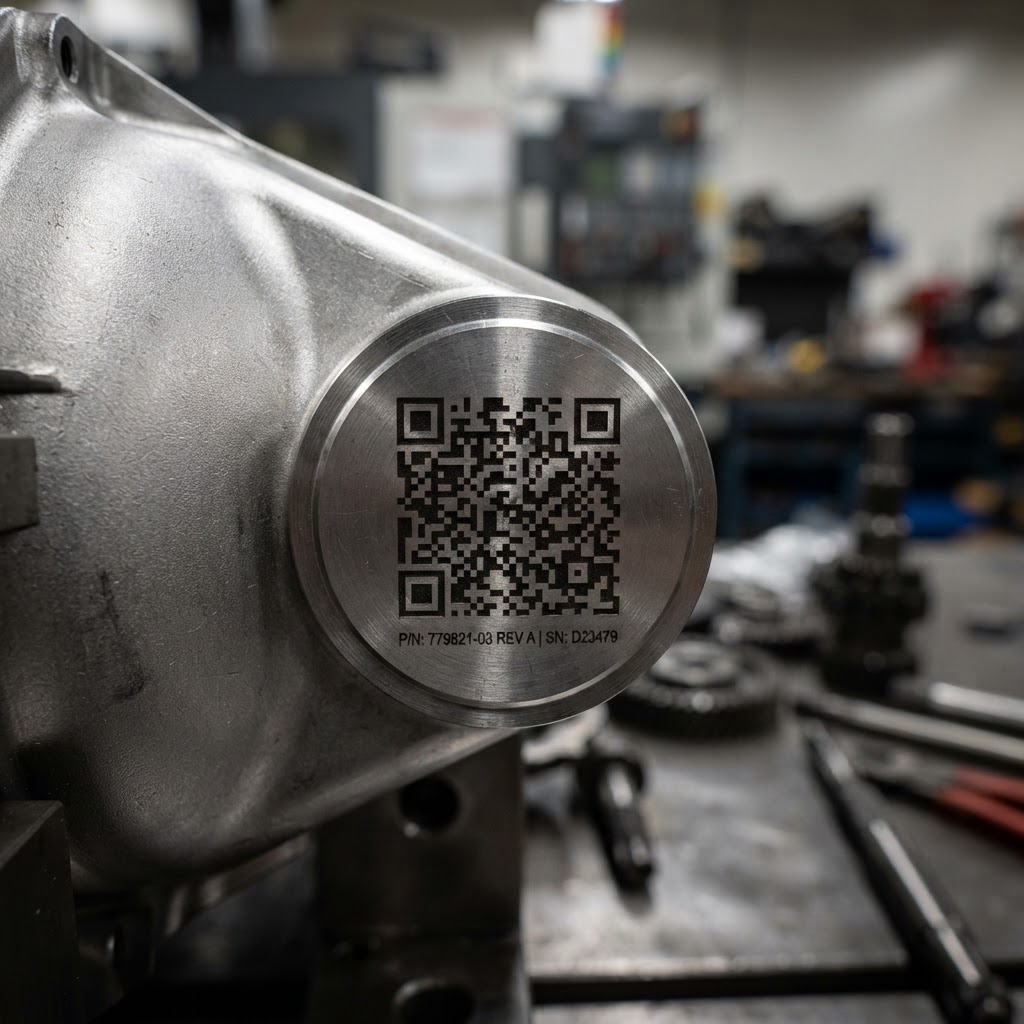
Why Data Matrix Codes Are Replacing Barcodes on Metal Parts
Need this made for your team?
Send your artwork or idea and we will come back with a price in one business day. Bulk pricing available.
You ever drop a wrench or a critical machine component and spend an hour trying to figure out if it is the right one for the job? If you are in the manufacturing or heavy industry game, you have been there. You have probably dealt with those old school stickers that peel off or the barcodes that get greasy and unreadable after two weeks on the shop floor. It is frustrating. Honestly, it is a waste of time and money. That is exactly why we are seeing a massive shift down here in our New Braunfels shop. People are ditching traditional barcodes and moving toward data matrix code engraving for their metal part identification.
Why the old way is failing you
Look, traditional linear barcodes are fine if you are selling cereal boxes at a grocery store. They are simple and they work when the environment is clean. But when you are dealing with industrial parts, things get messy quickly. A barcode needs a lot of real estate. It needs a high contrast background. If you scratch the middle of a linear barcode, the scanner often gives up. It cannot read the data because the pattern is broken.
We see this all the time with customers coming into Perfect Etch. They show us parts that have been through heat, vibration, or exposure to harsh chemicals. A paper label or an ink jet print on a metal part is basically a ticking time bomb. It might last until the end of the shift, but once that metal part hits the field, that identification is gone. That is where 2D barcode engraving changes the game.
The power of the data matrix
A data matrix code is a two dimensional grid of squares. Think of it like a mosaic. Because it is a 2D format, it stores a whole lot more information in a much smaller space. You can cram a serial number, a part number, and even a batch code into a tiny square that is maybe a quarter inch wide. But the real magic is the redundancy. Because the information is repeated throughout the pattern, the scanner can still read the code even if a big chunk of it is damaged or covered in dirt.
We have spent years refining our laser marking process at Perfect Etch to ensure these codes are deep enough to survive. If you are marking steel, aluminum, or even titanium, you want a mark that does not just sit on the surface. We use high powered fiber lasers to remove a tiny amount of material, creating a high contrast mark that does not fade when exposed to the elements. You could paint over these marks, blast them with sand, or coat them in grease, and they will usually still scan perfectly. That is the kind of reliability that keeps a factory running without headaches.
Why metal part marking needs to be permanent
There is a big difference between a temporary tag and a permanent asset. When you send a part out the door, you are taking responsibility for its quality. If there is a recall or a simple maintenance check five years later, you need to know exactly when that part was made and what material went into it.
We see a lot of shops in Central Texas trying to save a buck by using stamps or manual engraving tools. The problem with those is the human element. Stamps get misaligned or blurry. Manual engraving is shaky and inconsistent. With laser technology, every single part comes out looking identical. That precision makes life so much easier for your quality control team. When the scanner hits every part the first time, your line keeps moving. That is how you stay profitable.
Getting the contrast right
Here is the thing about laser marking metal. It is not just about burning a design onto the surface. You have to consider the material properties. Some metals react better to annealing, which is where the laser changes the surface chemistry to create a dark mark without actually digging deep into the metal. This is common in medical devices because it creates a smooth surface that does not trap bacteria.
Other times, you want an ablation mark where we physically cut into the surface. This is better for parts that get handled constantly or dragged across concrete. At our New Braunfels shop, we test the material before we commit to the laser settings. We have seen too many parts ruined by the wrong power settings or the wrong frequency. If you are doing this in house, you need to be ready to waste a few scrap pieces until you get that perfect, high contrast grid that your scanners love. If you do not have the time to tinker with laser focal lengths and pulse widths, that is exactly why we are here to help.
Beyond the basics
It is not just about labels and barcodes either. We have helped plenty of local businesses brand their metal signs and even customize high end drinkware using these same laser technologies. When you have the equipment to mark a data matrix code on a hardened steel gear, you can also do some pretty incredible branding on a stainless steel tumbler or a heavy duty entry sign for your shop.
The technology has moved way past just basic markings. We can integrate logos right next to your data matrix codes. You get the professional look of a brand logo combined with the industrial functionality of a scannable part code. It makes the part look finished, like it belongs to a company that actually cares about the details.
If you are currently struggling with barcodes that just will not scan or labels that keep falling off your parts, it might be time to look into switching to a permanent 2D solution. It is one of those small changes that ends up saving you a massive amount of stress in the long run. Feel free to swing by our shop here in New Braunfels or shoot us an email if you want to run some tests on a few of your parts. We are always happy to look at your project and see how we can get your part identification dialed in.
Tell us about your project
Share the basics and we will come back with pricing, options and a timeline. No obligation.