How to Choose Between Laser Marking and Chemical Etching for Metal Parts
Need this made for your team?
Send your artwork or idea and we will come back with a price in one business day. Bulk pricing available.
You have a precision part sitting on your workbench. It needs a serial number, a logo, or maybe just a simple ID tag to keep track of it in the shop. You know you need a permanent mark, but you are stuck choosing between the two heavy hitters of the industry. Should you go with laser marking or chemical etching?
I have seen plenty of folks in New Braunfels and across Central Texas struggle with this exact decision. It is not always about which one is "better" in a vacuum. It is about which one fits the specific metal you are using and how that part is going to live its life once it leaves our shop.
If you want a deep dive into the technical side of how we handle this, you should check out our Industrial Laser Marking & Metal Part Engraving guide. It covers the broad strokes of how we treat different materials at Perfect Etch. Otherwise, let us break down these two methods like we are just chatting over a cup of coffee.
What is actually happening during chemical etching?
Think of chemical etching like using a stencil and an acid bath. We apply a resist mask to the metal, then apply an etching agent that eats away at the exposed areas. You end up with a recessed mark. Because the metal is physically removed, the mark is deep and permanent.
Honestly, it looks fantastic on items like stainless steel signs or brass plaques. It gives you a clean, crisp, and high contrast look that is hard to beat for aesthetic display pieces. The downside? It is a messy, multi-step process. You have to deal with hazardous chemicals, neutralization, and disposal. For a high volume of small parts, it can feel a bit clunky.
Why laser marking has become the go-to for parts
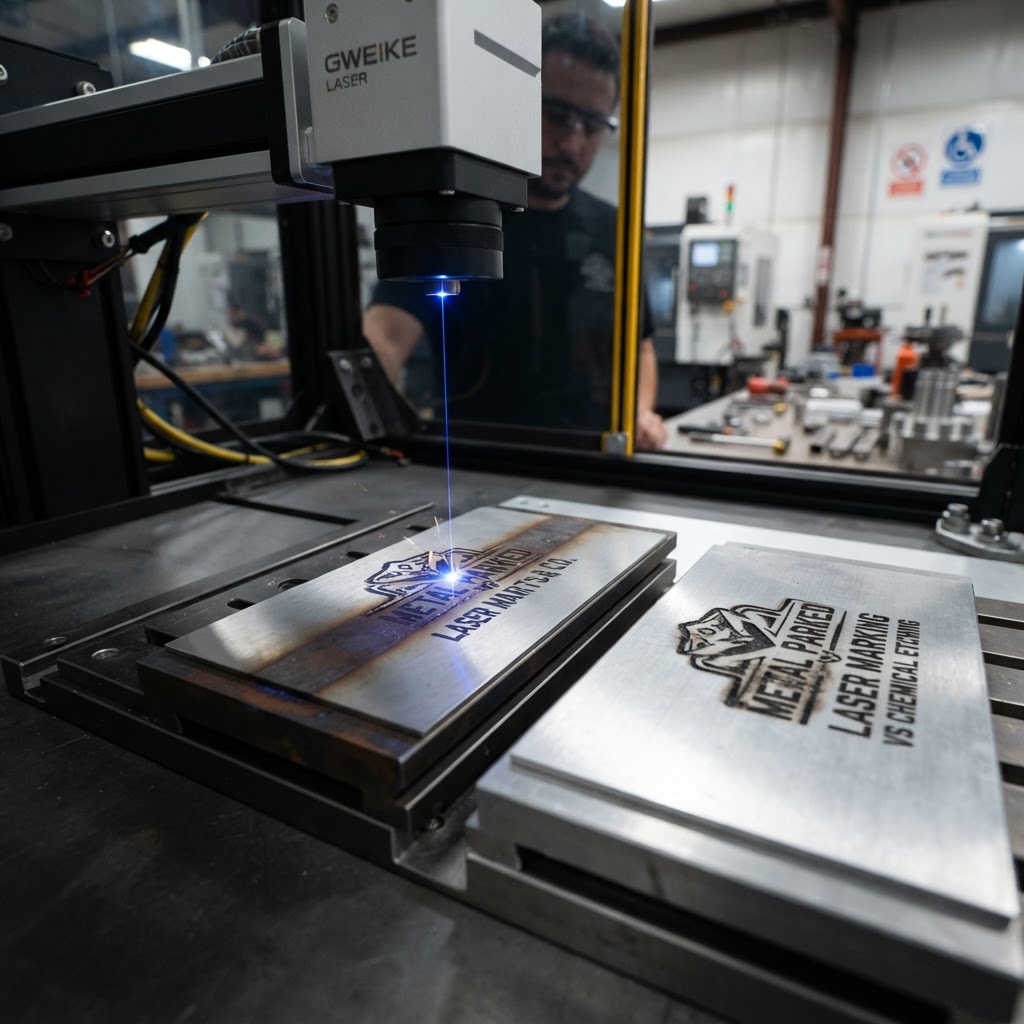
Here is the thing about laser marking. It is fast, it is clean, and it is incredibly precise. We use a concentrated beam of light to change the surface of the material. Depending on the settings we use, we can anneal the metal, which changes the color without removing material, or we can ablate the surface to create a high contrast etch.
Because we are not using chemicals, we are not creating hazardous waste. This is huge for us here in our New Braunfels shop because it allows us to handle everything in-house with way less cleanup. If you need to mark a serial number on a hard stainless steel component, a fiber laser will do it in seconds. The mark will be permanent, readable, and it will not compromise the structural integrity of your part.
Comparing your costs and setup
If you are running a prototype or just doing a one-off sign, chemical etching might seem cheaper on paper because you are not paying for expensive laser equipment time. But look closer at the labor. Making the screen or the mask for chemical etching takes time. If you need to change a single digit in a serial number, you are starting the process over.
With laser marking, we just type the new number into our software and hit go. If you are doing a run of 500 parts, lasers win every time. The setup is lightning fast and every single mark is identical. From a business perspective, if you are planning to scale up your production, skipping the chemical route usually saves you a massive amount of headaches.
Which one handles the elements better?
This is where a lot of people get tripped up. They worry that a laser mark will fade or disappear if the part sits outside. I can tell you from years of experience that a properly annealed laser mark is basically bulletproof. Because it is a color change within the metal structure itself, it does not sit on top of the surface. It is part of the metal.
Chemical etching is also great for harsh environments because the depth of the etch provides a physical channel. If you are painting over the mark, chemical etching is often the winner because the ink or paint can sit inside the groove. This makes for a very bold, readable mark that lasts through decades of weather and wear.
How to decide what you need
I always tell our local clients to ask themselves three questions before deciding.
First, what is your material? Some metals respond better to lasers than others. Anodized aluminum looks incredible with a laser, while certain grades of brass might look sharper with an etch.
Second, what is the volume? If you need ten thousand parts engraved with a unique serial number, you do not want to be anywhere near a chemical vat. You want a laser.
Third, what is the final look? If you want that deep, recessed feel for a custom sign or a decorative piece, nothing beats the look of a deep chemical etch. It has a tactile quality that is really classy.
If you are still on the fence, feel free to swing by our shop in New Braunfels. We usually have a few test pieces sitting around that show the difference between laser marking vs chemical etching side by side. Seeing it in person makes the choice much easier. We can grab a couple of scraps, run a few test marks for you, and see which one handles your specific material the best.
At the end of the day, there is no sense in guessing when you can see the result with your own eyes. Just give us a shout if you have a pile of parts that need some identifying marks. We are always around to help you figure out the cleanest, fastest way to get the job done right.
Tell us about your project
Share the basics and we will come back with pricing, options and a timeline. No obligation.