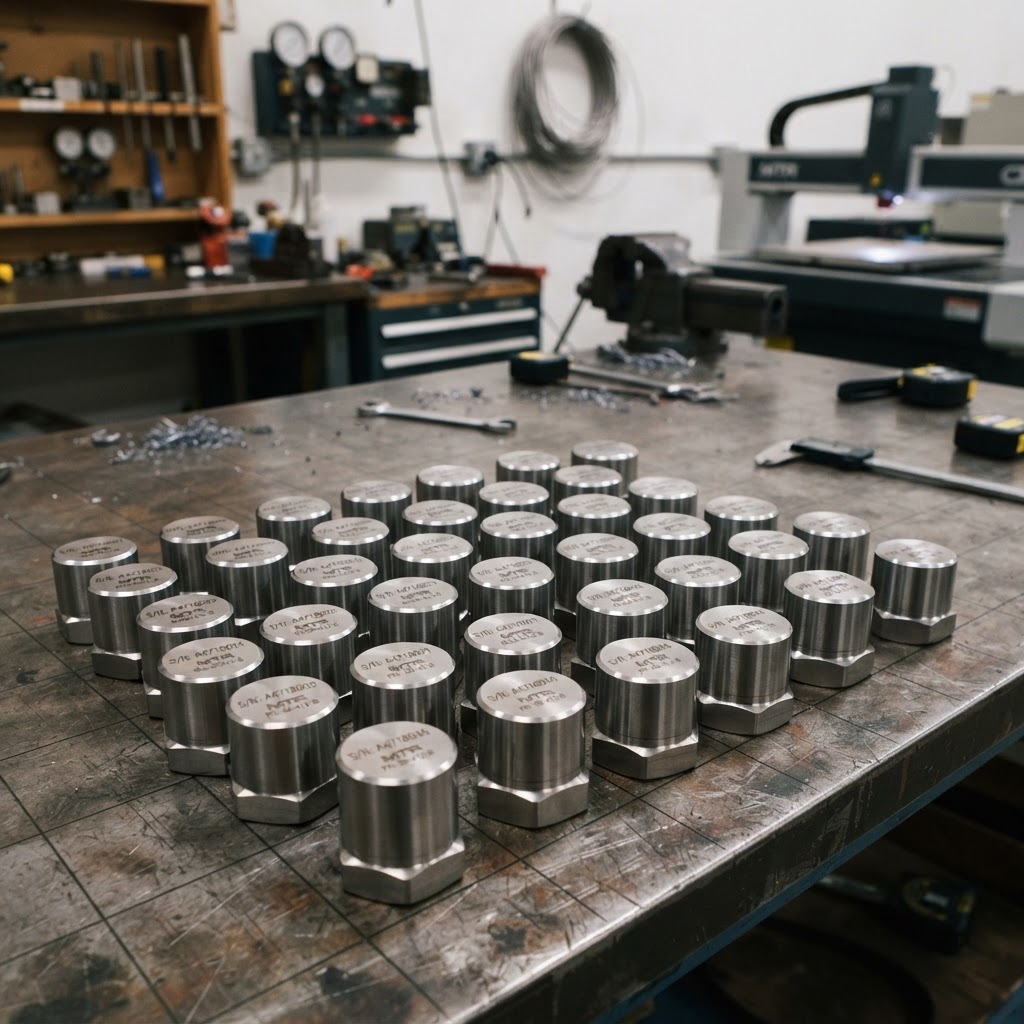
Engraving Serial Numbers on Metal Parts: What Manufacturers Get Wrong
Need this made for your team?
Send your artwork or idea and we will come back with a price in one business day. Bulk pricing available.
I have lost count of how many times a shop owner has walked into our New Braunfels facility with a box of expensive metal parts, only to realize their serial numbers are fading after just a few months of use. They usually spent good money on a marking machine or a third party service that looked fine on day one. But here is the thing. A serial number that vanishes or becomes unreadable is effectively useless. If you cannot track your part back to the production run or the material batch, you might as well have left it blank.
At Perfect Etch, we deal with industrial engraving every single day. We see what works and what falls apart under pressure. Most manufacturers get the basics wrong because they prioritize speed or cost over the actual physics of metal.
Why your markings might be disappearing
The biggest mistake I see involves choosing the wrong depth for the environment. A lot of folks go for a surface level mark because it is fast. If you are marking something that sits on a shelf in an office, sure, that works fine. But if you are working with automotive parts, aerospace components, or anything that faces heat, oil, or vibration, a shallow mark is just a temporary solution.
Look, laser engraving is not a one size fits all process. We have seen parts come in from all over Central Texas where the marking was performed at the wrong focal length or power setting. If you do not penetrate the surface enough, you are just staining the metal. Over time, oxidation or exposure to chemicals will eat that stain away. You want a physical impression in the material. When we do industrial engraving here, we calculate the depth based on the specific alloy. Stainless steel reacts differently than aluminum or titanium. If you treat them all the same, you are asking for trouble.
The problem with standard fonts and sizing
Another trap manufacturers fall into is trying to cram too much information into a tiny space using a font that looks good on a screen but fails in the real world. You might think a delicate, thin font looks professional. Honestly, it is a nightmare for traceability. If that part gets scratched, covered in grime, or painted over, that thin font is the first thing to disappear.
We always recommend using a bold, simplified block font for part serialization. It is easier to read and, more importantly, it holds up better if the part takes a hit. Also, consider the size. If your serial number is smaller than a few millimeters, a single burr or a light dent can make the difference between a readable character and a mystery shape. We keep our markers calibrated for high contrast and high durability. You want a serial number that a technician can read in poor lighting conditions while wearing gloves. If your marking requires a magnifying glass to decipher, you have already lost the battle.
Getting the material chemistry right
Here is a secret that surprises a lot of people. Not all metal reacts the same way to a laser. Some materials will actually suffer structural fatigue if you use the wrong laser parameters. If you overheat the area around the serial number, you might create a stress riser. That sounds like fancy engineering talk, but it just means you are creating a weak spot where a crack can start.
When we handle metal part serialization for our local clients, we look at the material composition first. If we are working with hardened steel, we have to use a specific pulse frequency to get a clean mark without causing micro fractures. If you are doing this in house and your parts start failing under stress tests, check your laser settings. You might be etching too deep or holding the heat in one spot for too long. We have spent years fine tuning our equipment here in New Braunfels to make sure we are not compromising the integrity of the parts we touch. That is why companies trust us with their critical components.
Why you need a real process, not just a machine
Some shops buy a laser engraver and think they are ready to go. They get a template and just start firing away. But part traceability marking is about consistency. If your serial number is 0.005 inches deep on one part and 0.010 inches deep on the next, you do not have a standard. You have a mess.
We utilize jigs and custom fixturing for every project. Even a slight wobble while the part is being marked can ruin the consistency of the serial number. If you are doing this yourself, do not rely on your hands or a makeshift setup. Build a jig that holds the part in the exact same spot every time. We have shelves full of custom holders we have made for various clients. It keeps the quality high and the process fast.
If you are currently struggling with markings that look blurry, fade out, or just do not stand up to the conditions your parts face, it is probably time to rethink the approach. It does not take a massive overhaul to fix these issues. Usually, it is just about slowing down, matching your settings to the specific metal you are using, and choosing a font that was actually built to be read.
We are always around the shop if you want to drop by and talk through a project. We like helping folks in the area get their processes dialed in, whether you need a few hundred serial numbers or a permanent solution for a specific industrial batch. You can reach out through our website or just stop by the shop in New Braunfels whenever you have a moment to chat about your next run of parts.
Tell us about your project
Share the basics and we will come back with pricing, options and a timeline. No obligation.