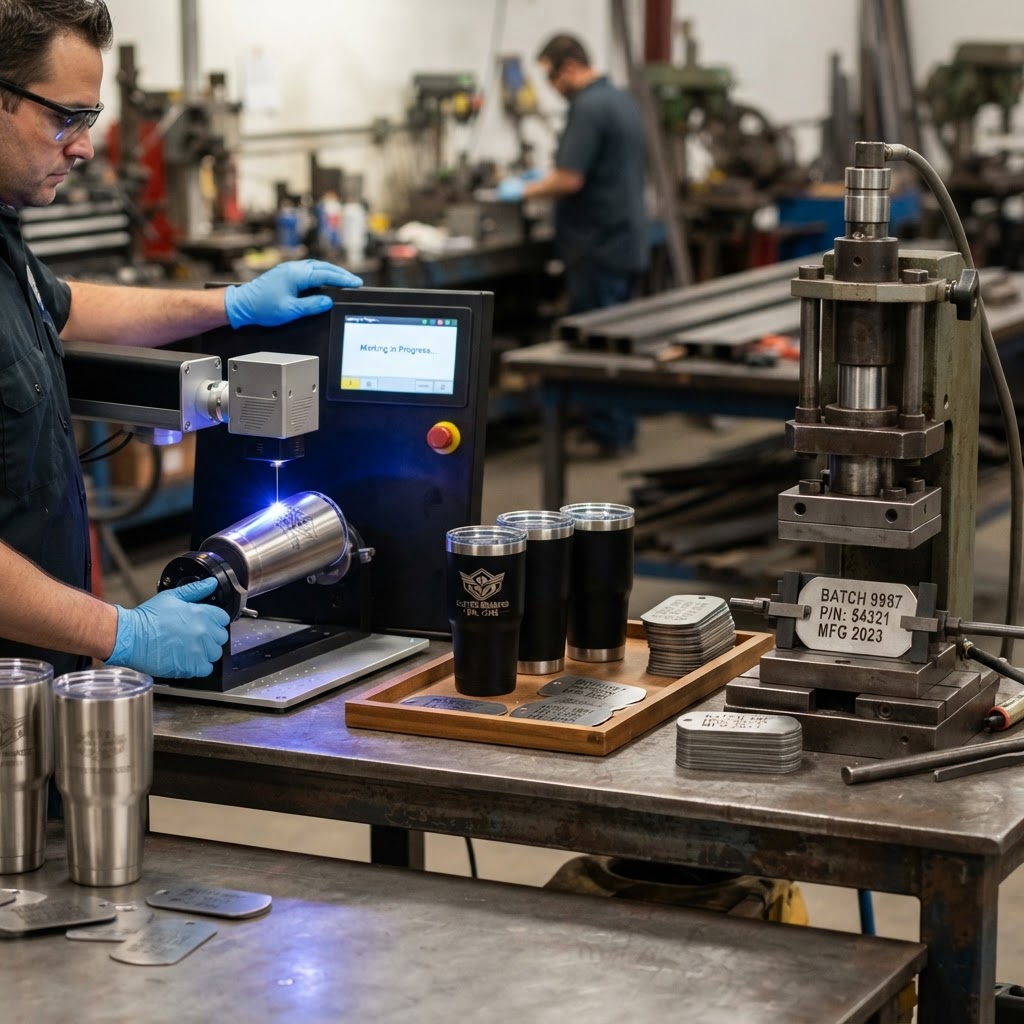
Laser Marking vs Stamping: Cost Comparison for Production Runs
Need this made for your team?
Send your artwork or idea and we will come back with a price in one business day. Bulk pricing available.
You know that feeling when you have a stack of metal parts on your workbench and you just need to get them marked? Maybe it is a batch of serial numbers, a logo, or just a part number for inventory. You have two main ways to get the job done. You can go the old school route with physical stamping, or you can use modern laser technology. I get asked by shop owners around New Braunfels all the time which one is cheaper. The answer is rarely a simple number. It depends on what you are actually trying to achieve.
We have spent years working with local businesses here in Central Texas to figure out exactly when one method makes more sense than the other. If you want to get into the nitty gritty of how these technologies work and how they fit into a larger production workflow, you should check out our Industrial Laser Marking & Metal Part Engraving guide. For now, let us break down the real cost differences for your production runs.
The true cost of physical stamping
When people think about metal marking, they usually picture a giant press or a hammer and a set of steel dies. Look, stamping is tough. It is fast for a single character or a simple logo. If you are doing ten thousand identical parts and you never change the information, stamping is cheap. You buy the die once, you set up the press, and you crank them out.
However, here is the thing that people often forget. Stamping has hidden costs. You have to pay for the custom dies to be manufactured. If your part design changes or you need to update a revision number, you are buying a whole new set of steel stamps. That can run you hundreds of dollars just for the tooling. Plus, stamping puts a lot of stress on the metal. It can deform thinner materials or leave marks on the backside of the part. If you have to scrap a few parts because the stamp distorted the material, that money adds up fast.
Why laser marking is changing the math
Honestly, laser marking has become the go to for most of our clients because it is so flexible. Unlike stamping, there is no physical tool to wear out. We do not need a die for every single variation of your logo or serial number. We load your file into the machine, hit a button, and the laser burns the mark into the surface.
Think about the setup costs. With laser marking, the setup is basically the cost of programming the file and getting the jig ready to hold your parts. Once that is done, you can change the text or the sequence of your serial numbers on the fly. You are not paying for new steel dies every time a project evolves. For smaller to medium production runs, this makes laser marking significantly cheaper than the stamping process. You save on the upfront tooling and you save on the lead time.
Where the numbers actually fall
Here is a practical breakdown of how we look at costs at Perfect Etch. If you are running 50,000 identical pieces, stamping might save you a few cents per unit on the actual marking time. But those cents disappear the moment you have to change a digit.
Most of our customers in the manufacturing world are doing runs of 50 to 5,000 parts. In that range, lasers win every single time. You aren't paying for the manufacturing of custom physical stamps. You aren't dealing with the maintenance of heavy press machinery. We can often get the job done and back to you much faster because we aren't waiting on a tool shop to mill out a new die.
Also, keep in mind that lasers are incredibly precise. You can fit a whole lot of information into a tiny space. We have marked parts with tiny data matrix codes that machines can read but humans can barely see. You simply cannot do that with a physical stamp.
The durability and aesthetic factor
Look, there is a perception that stamps are deeper and therefore tougher. That was true thirty years ago. Modern fiber lasers create deep, permanent marks that don't wash off, fade, or get polished away easily. We do high contrast annealing on stainless steel all the time. The mark is actually part of the metal itself. It is food safe, chemical resistant, and heat resistant.
When you factor in the cost of potential rework or scrap from a stamping press that went a bit too deep, laser marking starts to look like the safer financial bet. You are paying for consistency. Every single mark on every single part is exactly the same as the first one.
How to decide what is right for you
Before you pull the trigger on a marking method, look at your specific project. Are your parts going to change over the next year? If you think your part numbers or logos might need a refresh, do not even consider stamping. The cost of replacing dies will eat your profit margin alive.
Are your parts delicate? If you are working with thin gauge metal, a stamp is going to bend your parts. You will end up with a high reject rate. That is a cost that usually doesn't show up on the quote but it shows up in your wallet.
We love helping out the local businesses around New Braunfels. We've seen projects where a client thought they needed a huge industrial stamping setup, only to realize that laser marking could handle the job with zero tooling costs. If you have a bin of parts you are trying to figure out, feel free to drop by the shop or send us a message. We can look at your material and tell you if a laser is the right fit or if you should look at other options. Sometimes just seeing a sample mark makes the decision a whole lot easier.
Tell us about your project
Share the basics and we will come back with pricing, options and a timeline. No obligation.