Laser Marking for Medical Devices: What FDA Regulations Require
Need this made for your team?
Send your artwork or idea and we will come back with a price in one business day. Bulk pricing available.
If you have ever held a surgical tool or a specialized medical implant, you might have noticed a tiny, crisp string of characters etched right onto the metal. Most people don't look twice, but in the medical industry, those marks are the difference between life and death. They are the digital footprint of a device. They tell a story that starts at the manufacturing plant and ends inside a patient.
At Perfect Etch, right here in New Braunfels, we spend a lot of time working with manufacturers who need to get these marks exactly right. It is not just about making something look pretty. When you are dealing with FDA requirements, there is zero room for error.
The basics of UDI compliance
The FDA has a specific set of rules for medical devices known as the Unique Device Identification system, or UDI. Simply put, the FDA wants to be able to track a device from the moment it leaves the shop floor to the moment it is removed from a patient.
Think of it like a VIN number on your car. If a part has a defect, the manufacturer needs to know exactly which batch it came from so they can issue a recall. Without a permanent, readable mark, you are flying blind.
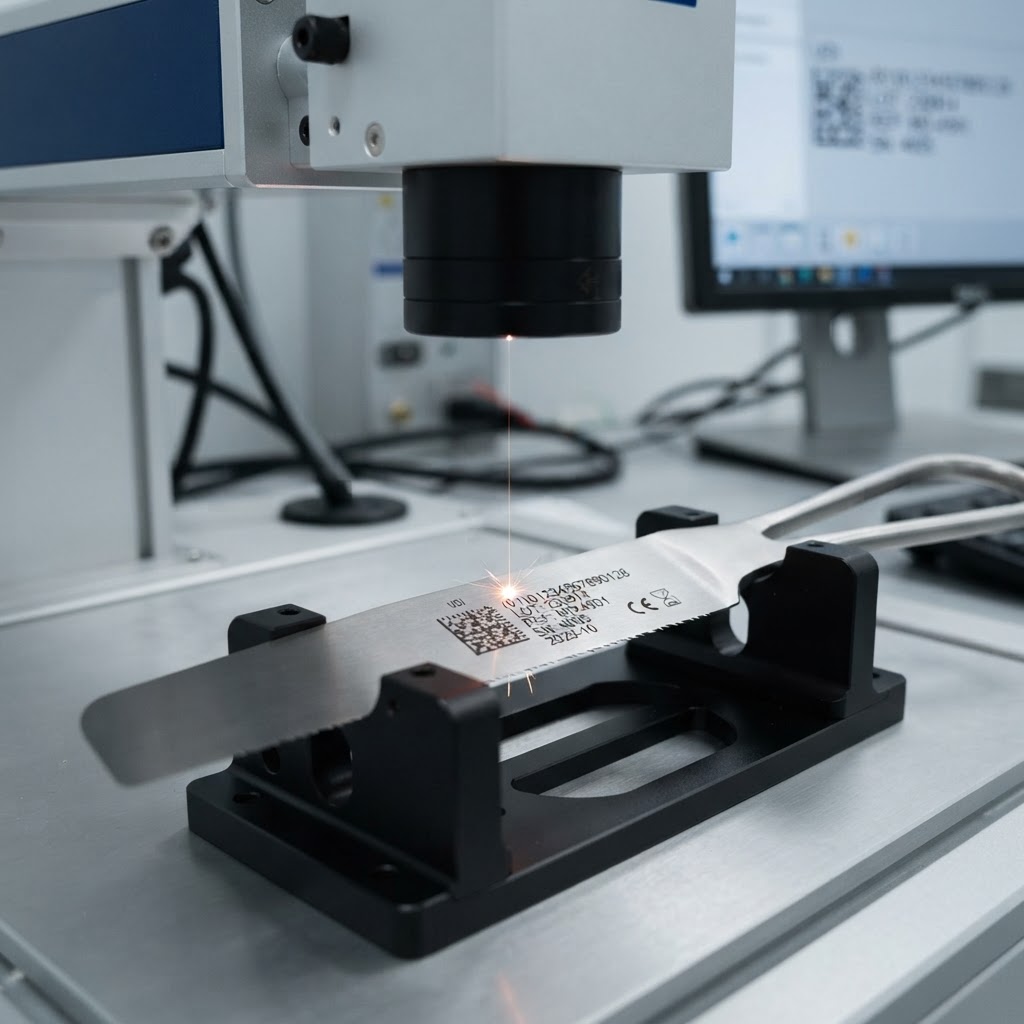
Here is the thing. The mark has to be permanent. You cannot just use a sticker or an ink jet print that rubs off after a few rounds in an autoclave. That is where laser marking comes in. Because we are vaporizing a tiny layer of the material or changing its surface structure, the mark stays put forever. It survives sterilization, repeated cleaning, and harsh hospital chemicals.
Why laser marking is the gold standard
Look, there are other ways to put information on metal. You could use chemical etching or mechanical stamping. But mechanical stamping puts a lot of stress on the part. If you are dealing with a delicate surgical blade or a tiny component, you do not want to strike it with a heavy steel die.
Laser marking is different. It is a non-contact process. We use a high-powered beam of light to change the surface of the metal without physically crushing or bending the part. It is precise enough to fit a huge amount of data into a tiny space. We are talking about human-readable text alongside complex 2D data matrix codes that scanners can read in a fraction of a second.
If you are curious about the technical side of how this process compares to other engraving methods, we have put together a guide on Industrial Laser Marking & Metal Part Engraving that breaks it all down in plain English.
Avoiding common pitfalls with FDA markings
Honestly, the biggest mistake we see companies make is underestimating the contrast required for scanners. You might have an engraving that looks great to the naked eye, but if a camera scanner at a hospital cannot pull the data off that surface, the mark is useless.
The FDA requires these marks to be legible for the entire life of the device. If your device is meant to be reused hundreds of times, the mark has to hold up through hundreds of rounds of high-heat steam sterilization. We have seen plenty of parts come into our New Braunfels shop that had marks which faded after a couple of cycles. That is a liability nightmare.
You need to select the right laser frequency for the specific metal alloy you are working with. Stainless steel, titanium, and aluminum all react differently. If you are marking titanium, you can actually create color changes using heat, which is cool to look at, but you have to make sure that color change stays stable. With stainless steel, we are usually looking for a high-contrast black mark that stands out against the shiny surface. Getting that balance right takes practice and a few test runs.
Why depth and clarity matter
When you are planning your marking strategy, remember that depth is not always your friend. If you go too deep, you create a crevice where bacteria can hide. In a sterile environment, that is a big no-no. You want a mark that is surface-level enough to be easily cleaned but deep enough to withstand abrasion.
We always suggest doing a validation run. Take a sample, mark it exactly how you intend to, and then run it through a simulated sterilization cycle. Use a high-quality scanner to verify the UDI data. If it reads perfectly after being scrubbed and heated, you are on the right track.
We have worked with a lot of local businesses in Central Texas to refine these processes. Sometimes it takes tweaking the speed, power, and frequency settings by just a fraction to get that perfect, crisp finish that meets all regulatory standards. It is a bit like tuning an instrument. It takes a sharp eye and a steady hand.
Keeping things simple for your team
If you are the one responsible for getting these devices marked, do not feel like you need to solve every technical puzzle on your own. There is a lot of guidance available in the FDA regulatory documentation, but applying that to real-world metal parts is a different story.
The goal is to create a process that is repeatable. You don't want to spend all day fiddling with settings for every single order. Once you find the sweet spot for your specific material and device shape, lock those settings in.
Traceability is not just a government requirement. It is a service to the people using your tools. Whether it is a laser-engraved piece of custom drinkware we do for a client or a critical medical component, we take pride in the fact that our marks are built to last. If you are struggling with your current marking process or just need help figuring out how to get a clean, compliant UDI code on your specific metal components, feel free to reach out and let us take a look. We are always happy to chat about what works best for your specific project.
Tell us about your project
Share the basics and we will come back with pricing, options and a timeline. No obligation.